

Weekend Waves 26/26
⚙️ AI Expands Into Media Workflows and Contracts

Happy Friday, Wavemakers!
Today is a bit of a fun one - the 26th in week 26 in ‘26. Feels like the kind of alignment that only shows up once in a while. But the alignment in this week’s news is actually more interesting than the calendar.
Across studios, platforms, and brands, a similar pattern keeps showing up: AI moving deeper into how media is actually built, creators being pulled further upstream into product decisions, and platforms quietly reshaping themselves around legacy formats like TV.
Here are the top 3 stories making waves this week:
1️⃣ Google x A24 AI Deal
2️⃣ Peppa Pig AI Backlash
3️⃣ Instagram Pushes Into TV
Let’s dive in!
🌊 News that Made Waves
Google Invests $75 Million in A24 to Develop AI-Powered Filmmaking Tools.
A24 and Google have struck an AI research partnership that will see the independent studio work with Google’s DeepMind unit to develop new AI-powered technologies for filmmakers. Google’s roughly $75 million investment is tied to the partnership and is in line with what Thrive Capital invested during the studio’s last funding round, according to the Wall Street Journal. The partnership will give A24 access to DeepMind’s research and infrastructure, while DeepMind researchers will work with the studio to build out new workflows. The deal does not give Google access to A24’s content library or its data. (Variety)
💡What stands out to me is how quickly AI is moving from experimentation to infrastructure. It’s no longer a separate toolset on the side - it’s being built directly into how production companies operate.
Peppa Pig’s AI Clause Sparks Industry Backlash.
Hasbro is facing criticism after Deadline revealed that child voice actors auditioning for Peppa Pig are being asked to sign contracts granting the company broad rights to replicate and use their voices with AI. Parents reportedly must accept the AI clause as a condition of casting, prompting concerns that young performers are signing away control over their digital identities before they can fully understand the implications. The revelation has led to an open letter signed by hundreds of actors, parents and industry professionals calling for stronger protections for child performers. The controversy has become another flashpoint in the entertainment industry’s broader debate over AI, consent and the ownership of performers’ voices and likenesses. (Deadline)
💡This goes beyond “AI in entertainment” and exposes a more uncomfortable shift: rights over a performer’s voice are being signed away upfront, before any real leverage or understanding exists - especially troubling when the performers are children.
Meta Leans Into Traditional TV Formats With Expanded Instagram For TV Feature.
Instagram is ramping up its efforts to attract more viewers on television in a way that may look very, well, old-school. Starting Monday, the Meta-owned social app will be testing out horizontal video on Instagram for TV, their preexisting feature that allows viewers to watch social videos on the big screen in their living room. And that’s not all. Coming soon, the company will also be experimenting with longer-form storytelling and episodic series with creators, in addition to trying live TV creator experiences on for size. The changes are timed to the launch of Instagram for TV on Samsung TV devices on Monday, a move that will significantly extend the reach of the feature. Previously, Instagram for TV was only available on Amazon Fire and Google TV products. In an interview with The Hollywood Reporter, Instagram vp of product Tessa Lyons called television “the next frontier” for the app. “Ultimately Instagram is all about connecting people around creativity. We’re all about helping creators find their audiences and we’re constantly evolving how we do that in order to meet [their] needs,” she said. “And I really think that TV is in so many ways the next frontier of that for us.” Also rolling out on Monday is the ability for users to be able to watch “Stories” (limited-time posts that appear on the top of Instagram feeds) on TV, after the app’s audience asked for it. Also new is a test run for users to cast reels from their phone onto their TV. (THR)
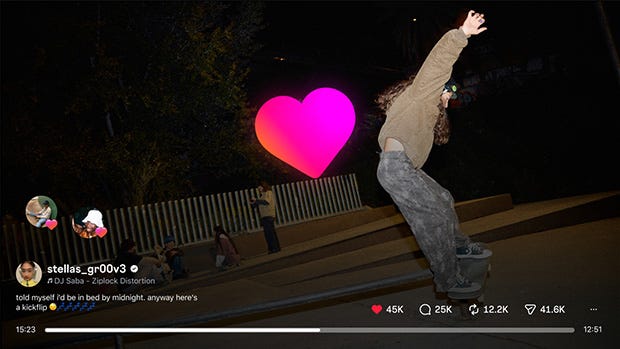
💡What stands out here is how social platforms are no longer just borrowing from TV, but they’re actively rebuilding their products around traditional TV viewing habits in order to make short-form ecosystems work on the biggest screen in the house.
Lowe’s Wants Its Content Creator Network to Start Pitching Products.
After launching the Lowe’s Creator Network last year, the brand is taking creator involvement a step further with Lowe’s Creator: Into the Blue. The new initiative allows its network of 28K creators to submit new product ideas and collaboration ideas for existing products that need more retail exposure. After its exclusive MrBeast toy set, the brand is likely hoping for more viral products that can reel in young shoppers—and spending parents. Beyond its creator network, Lowe’s has zoned in on creating unexpected experiences for young people, from its World Cup campaign with a 10-foot Lionel Messi inflatable to campaigns with A’ja Wilson, Jalen Brunson, and Live Nation Music. (Marketing Dive)
💡This is a shift from creator marketing as distribution to creators as upstream input, with brands starting to treat creator networks as a structured way to source product ideas rather than just amplify existing ones.
TikTok, Tinder Swipe Right on Double Date Island with Studio 55, Cowshed.
Dating app Tinder, ITV Studios-owned Studio 55 and digital outfit Cowshed Studios are collaborating on an international reality series that will launch soon on social video giant TikTok. The first season of Double Date Island, produced by Cowshed Studios, co-developed by Studio 55 and distributed by Zoo 55, also part of ITV Studios, will premiere on TikTok this summer. The series is being made with the support of OMD, Tinder’s agency in EMEA for media strategy, planning and buying. Double Date Island was initially launched by Tinder last year to tie in with a new feature on the app that allows users to go on double dates together.
The reality dating show sees pairs of best friends selected from the US, Brazil, Australia, the UK, France, Spain, Italy and Germany to go on double dates. (C21 Media)

💡Dating apps are increasingly turning in-app social features into externally produced entertainment formats, effectively extending product engagement into content production for platforms like TikTok.

🧠 Strategy Spotlight: AI Expands Into Media Workflows and Contracts
We’re past the point where AI is a tool creative industries experiment with. It’s now being embedded into the systems that decide how media gets made, distributed, and owned. What’s emerging across studios, platforms, and even contracts isn’t a series of isolated AI use cases, but a broader structural shift.
AI is starting to sit underneath the industry’s core functions - not just supporting creative work, but actively shaping the conditions around it.
From Experimentation to Production Infrastructure
The clearest signal comes from the partnership between Google and A24. On the surface, it’s a $75 million investment into AI filmmaking tools. But the more important detail is what is actually being built: workflows.
Instead of treating AI as an external add-on for creators to experiment with, Google DeepMind is working directly with a studio to help design production systems from within. That shift matters because workflows are where creative industries either evolve or stay structurally the same. Once AI is embedded there, it stops being optional and becomes part of how work is done.
This is the move from isolated tools to integrated infrastructure.
From Tools to Terms AI Enters Contracts
At the other end of the spectrum, the Peppa Pig backlash shows a very different but connected development. AI is no longer only a production question - it is becoming a contractual one.
Child voice actors being asked to sign away AI replication rights before they even begin work signals a shift in where control is established. It moves AI out of post-production debates and into the earliest stage of the value chain: consent, ownership, and leverage.
The reaction is not just about one show. It reflects a broader tension emerging across entertainment industries:
Once AI replication becomes standard, control over identity becomes something negotiated upfront rather than after the fact.
From Platforms to Formats
Meta’s push to expand Instagram for TV adds another layer to the same shift. The platform is experimenting with longer-form storytelling, episodic content, and horizontal viewing experiences designed for the living room screen.
This is not just a distribution update. It signals a change in format logic. Platforms built for scrolling are beginning to test structures that resemble programming.
The result is a hybrid model where algorithmic feeds start to intersect with traditional television behaviours.
From Distribution to Co-Creation
The pattern also shows up outside traditional entertainment. Lowe’s turning its creator network into a product ideation system moves creators upstream, from marketing amplification into product development itself.
And TikTok’s collaboration with Tinder on Double Date Island shows how in-app behaviours are increasingly being translated into standalone entertainment formats, extending platform logic into externally produced content.
The Common Thread
The common thread across these developments isn’t AI itself, but where it’s being inserted. It’s moving away from being a tool used inside creative processes and closer to the points where decisions are made - what gets produced, how it gets licensed, and how it reaches audiences.
Instead of sitting in the workflow, it’s starting to influence the conditions that shape the workflow in the first place.
⏪ ICYMI: The Merger Myth: Why Bigger Won’t Save TV
Every few years, the media industry reaches the same conclusion:
We need bigger companies.
Bigger libraries.
Bigger distribution.
Bigger balance sheets.
Two weeks ago, I joined industry leaders at NEM Dubrovnik to discuss whether media companies need to get bigger to survive.
But the more I thought about it, the more I wondered: What if we're focusing on the wrong kind of scale?
While media companies continue talking about consolidation, audiences are doing the exact opposite. They're fragmenting their attention across YouTube, TikTok, Netflix, podcasts, gaming and creators.
And some of the most interesting acquisition strategies today aren't about buying content at all. They're about buying proximity to changing audience behaviour.
Take Fox, for example. Over the past two years, it has invested in creator businesses, podcast subscription infrastructure and vertical video platforms. Not content libraries. Capabilities.
In my latest Beyond the Hype newsletter, I explore why the future of media M&A may be shifting from scale acquisitions to capability acquisitions - and why the biggest merger happening right now isn't between media companies at all.

What do you think? Does TV still need bigger companies to compete, or does it need a different strategy entirely?
☀️ Weekend Vibes
If something sparked a thought, or you think a friend would enjoy this, hit reply or forward it along. Sandra x
Please feel free to reach out to me if you would like to discuss this further or if you have any questions: sandra@tvfuturist.com or connect with me on LinkedIn.